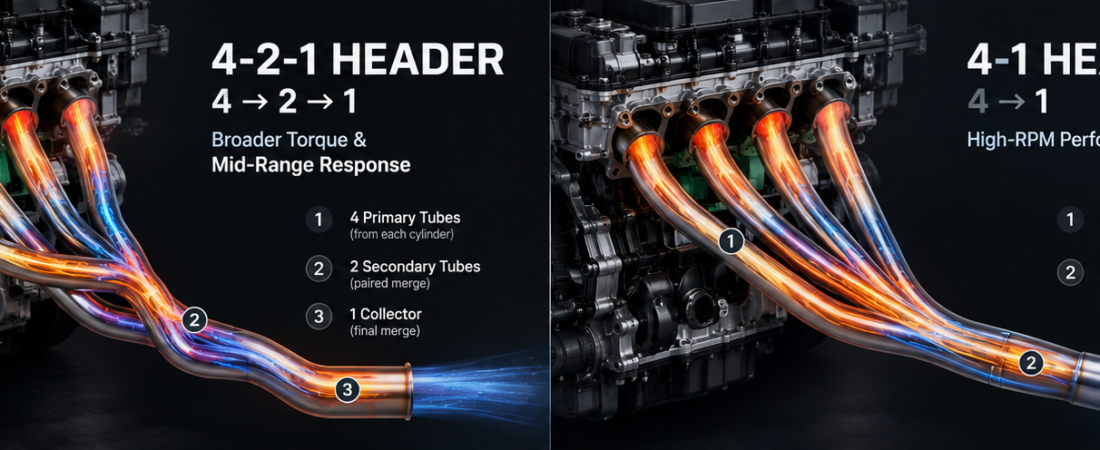
Choosing the right performance header can change how your engine delivers power. Two common designs are 4-2-1 headers and 4-1 headers. Both improve exhaust gas flow, but they are designed for different performance characteristics. So, what is the difference between 4-2-1 vs 4-1 headers? And which one is right for your car? In this guide, we explain the differences, benefits, and typical applications of both header designs.
What Is a Performance Header?
A performance header replaces the factory exhaust manifold. It uses individual tubes for each engine cylinder. These tubes are designed to improve exhaust gas flow and reduce restrictions. Better exhaust flow can help the engine breathe more efficiently. However, the final result depends on many factors, including tube diameter, tube length, collector design, engine size, camshaft, RPM range, and the rest of the exhaust system.
What Is a 4-2-1 Header?
A 4-2-1 header uses four primary tubes. The four tubes merge into two secondary tubes. These two tubes then merge into one final collector. The basic design is 4 → 2 → 1. This configuration is commonly used when a broad powerband and strong low-to-mid RPM response are important. It can work well for street cars, daily drivers, and naturally aspirated engines that need useful power across a wide RPM range.
4-2-1 Header Benefits
A 4-2-1 header can provide a smoother and broader torque delivery. It is often suitable for street driving because the engine operates across many different RPM ranges. The design also allows exhaust pulses to work together through the staged merging of the tubes. As a result, the engine can have useful torque across a wider part of the RPM range. However, the actual performance depends heavily on the header dimensions and engine combination.
What Is a 4-1 Header?
A 4-1 header uses four primary tubes that merge directly into one collector. The basic design is 4 → 1. Unlike a 4-2-1 design, there are no secondary tubes. This configuration is commonly associated with performance applications where higher-RPM power is important. A properly designed 4-1 header can help support strong exhaust flow at higher engine speeds.
4-1 Header Benefits
The main characteristic of a 4-1 header is its more focused power delivery. It is often chosen for engines that spend more time at higher RPM. This can make it suitable for racing, track cars, and performance-oriented builds. However, this does not mean every 4-1 header will automatically produce more peak power. Header diameter, primary length, collector size, engine specifications, and tuning all affect the final result.
4-2-1 vs 4-1 Headers: Main Differences
The biggest difference is the way the primary tubes merge. A 4-2-1 header uses two stages of merging, while a 4-1 header merges all four primary tubes into one collector.
| Feature | 4-2-1 Header | 4-1 Header |
|---|---|---|
| Tube layout | 4 → 2 → 1 | 4 → 1 |
| Primary tubes | 4 | 4 |
| Secondary tubes | 2 | None |
| Final collector | 1 | 1 |
| Main focus | Low-to-mid RPM | Mid-to-high RPM |
| Torque delivery | Broad and smooth | More focused |
| Powerband | Broad | More focused |
| Street driving | Very suitable | Suitable |
| High-RPM performance | Suitable | Strong |
| Typical application | Street & daily driving | Performance builds |
In simple terms, 4-2-1 headers are generally designed for a broader torque curve, while 4-1 headers are generally designed for more focused high-RPM performance. The exact result can vary depending on the engine and header specifications.
How Does Exhaust Scavenging Work?
Exhaust scavenging is an important part of header design. When an exhaust valve opens, a high-pressure exhaust pulse travels through the primary tube. The movement of this pulse can help create a pressure difference that assists the next exhaust event. This effect can help remove exhaust gases from the cylinder.
The timing of these exhaust pulses depends on tube length, tube diameter, firing order, and collector design. Therefore, header design is not simply about making the tubes larger. The dimensions need to match the engine and its intended RPM range.
Which Header Is Better for Street Cars?
For many street cars, a 4-2-1 header can be a practical choice because it is designed around a broader RPM range. Street engines often need useful torque during acceleration, overtaking, and normal driving. A broad torque curve can make the car feel more responsive across different speeds.
However, a 4-1 header can also work well on a street car. This is especially true when the engine has been modified to operate at higher RPM. Camshaft specifications, compression ratio, engine displacement, intake system, ECU tuning, and exhaust system should all be considered before choosing a header.
How to Choose the Right Header
Start with your engine and how you use the car. If the car is mainly used for daily driving, street performance, or mixed driving, a 4-2-1 design may fit the intended powerband. If the engine is built for higher RPM performance, a 4-1 design may be more appropriate.
Next, consider the header dimensions. Primary tube diameter and length have a major effect on exhaust gas velocity and pulse behavior. The collector also plays an important role. Therefore, choosing a header only by its 4-2-1 or 4-1 configuration is not enough.
You should also consider the complete exhaust system. The header, catalytic converter, resonator, muffler, pipe diameter, and engine tuning all work together. A good header should be matched to the rest of the system.
4-2-1 or 4-1 Headers?
There is no universal header design that is best for every engine. A 4-2-1 header is generally focused on broad torque and mid-range response. A 4-1 header is generally focused on higher-RPM performance.
The right choice depends on your engine, modifications, RPM range, and driving style. For this reason, header design should always be matched to the specific vehicle and its intended use.
Grumung Performance Headers
At Grumung Exhaust, we focus on handcrafted performance headers designed around the needs of each vehicle. Every header is made with attention to tube routing, collector design, fitment, and exhaust flow.
Our headers are handcrafted in Purbalingga, Indonesia. We build different configurations for different engines and applications. Whether you are looking for a 4-2-1 header for street performance or a 4-1 header for a higher-RPM build, the design should be matched to the engine and vehicle.
Your Car. Your Sound. Your Build.
Frequently Asked Questions
What is the difference between 4-2-1 and 4-1 headers?
A 4-2-1 header uses four primary tubes that merge into two secondary tubes and then one collector. A 4-1 header merges four primary tubes directly into one collector. The two designs have different exhaust pulse and powerband characteristics.
Is a 4-2-1 header better for daily driving?
A 4-2-1 header is generally well suited to daily driving because it is designed to provide a broader torque range. However, the actual result depends on the engine and header specifications.
Is a 4-1 header better for high RPM?
A 4-1 header is generally associated with higher-RPM performance. However, tube dimensions, collector design, engine specifications, and tuning also affect the result.
Does a bigger header always make more power?
No. Bigger is not always better. If the tubes are too large for the engine and its RPM range, exhaust gas velocity can be affected. Proper tube diameter and length should be matched to the engine.
Which header should I choose?
Choose based on your engine specifications, RPM range, modifications, and intended use. A 4-2-1 design is generally suited to a broader powerband, while a 4-1 design is generally suited to more focused high-RPM performance.